What is matcha?
Matcha is a Japanese green tea: the leaves are shade-grown, then ground into a fine powder. When you drink it, you consume the whole leaf, caffeine included.
What is moringa?
Moringa comes from a tree, Moringa oleifera, grown for centuries in Africa and Asia. It’s the leaves—dried and then ground into powder—that are consumed. They contain no caffeine at all.
So both come as bright green powders that you whisk into hot water or plant-based milk. But they have almost nothing in common: not the plant, not the origin, not the effect you’re looking for. Here’s our point-by-point comparison.
Energy and caffeine
Matcha contains caffeine—generally between 30 and 70 mg per cup (for 1 to 2 g of powder), or about half a drip coffee. It also contains L-theanine, an amino acid that softens caffeine’s effect, resulting in calm, steady alertness that lasts for several hours—without coffee’s spike or sudden crash.
Moringa contains no caffeine at all, so its energy is a different kind. It comes from its richness in iron, magnesium, and B vitamins—nutrients that support the body’s energy production. No stimulant effect and no energy crash, but steady, foundational support you can take morning or night without worrying about your sleep.
What nutrients does each one contain?
Matcha: a targeted profile. It stands out for its antioxidants, especially catechins (including EGCG), and for its L-theanine. It’s the combination of antioxidants and focus.
Moringa: a broad profile. Per 100 g of leaf powder, you’ll find roughly:
- about 25 g of complete plant protein (all 9 essential amino acids, which is rare for a plant)
- about 2,000 mg of calcium
- about 40 mg of iron
- a high vitamin A content (in the form of beta-carotene), in addition to vitamins C, E, K and potassium
Exact values vary by harvest. Where matcha concentrates a few standout compounds, moringa covers a much broader spectrum of essential nutrients. In a smoothie or latte, a spoonful of moringa is closer to a small greens concentrate than a simple drink.
What about iron? Matcha contains no iron, and its polyphenols can reduce iron absorption from a meal eaten at the same time. It’s more a matter of timing than a problem. Moringa works the other way: it provides iron, and paired with a source of vitamin C (baobab, for example), that iron is absorbed even better.
Taste
Matcha: a rich, vegetal, umami taste—sometimes slightly bitter if the quality or preparation isn’t great. It’s an acquired taste, and its fans love it.
Moringa: a milder, more subtle taste—lightly herbal, close to fresh spinach or a very gentle green tea, without pronounced bitterness. It blends easily into a fruit smoothie, juice, or a bowl of yogurt without taking over. As a latte, with plant-based milk and a touch of maple syrup or honey, it becomes comforting.
If matcha’s taste has ever put you off, moringa is worth a try—the experience is much gentler.
And the price?
Ceremonial-grade matcha: in Canada, it commonly sells for $80 to $180 per 100 g. At 2 g per cup, that works out to about $1.60 to $3.60 per cup, just for the powder. Cheaper “culinary” matchas are meant for baking and blends, with a different taste and profile.
Terraïka moringa leaf powder: it’s $14.99 for 125 g. A generous 5 g serving (a heaping teaspoon) costs about $0.60. You can use it morning and night, every day.
So day to day, moringa costs at least three times less per cup than ceremonial matcha.
How to enjoy them?
Matcha: it’s all about the ritual. Whisked with hot water, in a latte, sometimes in dessert. Its caffeine does limit the timing though: past midday, many prefer to skip it.
Moringa: any time of day, in several forms:
- in a latte, hot or iced
- in a smoothie or green juice
- sprinkled on a bowl, soup, or vinaigrette
- worked into recipes, from energy balls to slow-cooked dishes
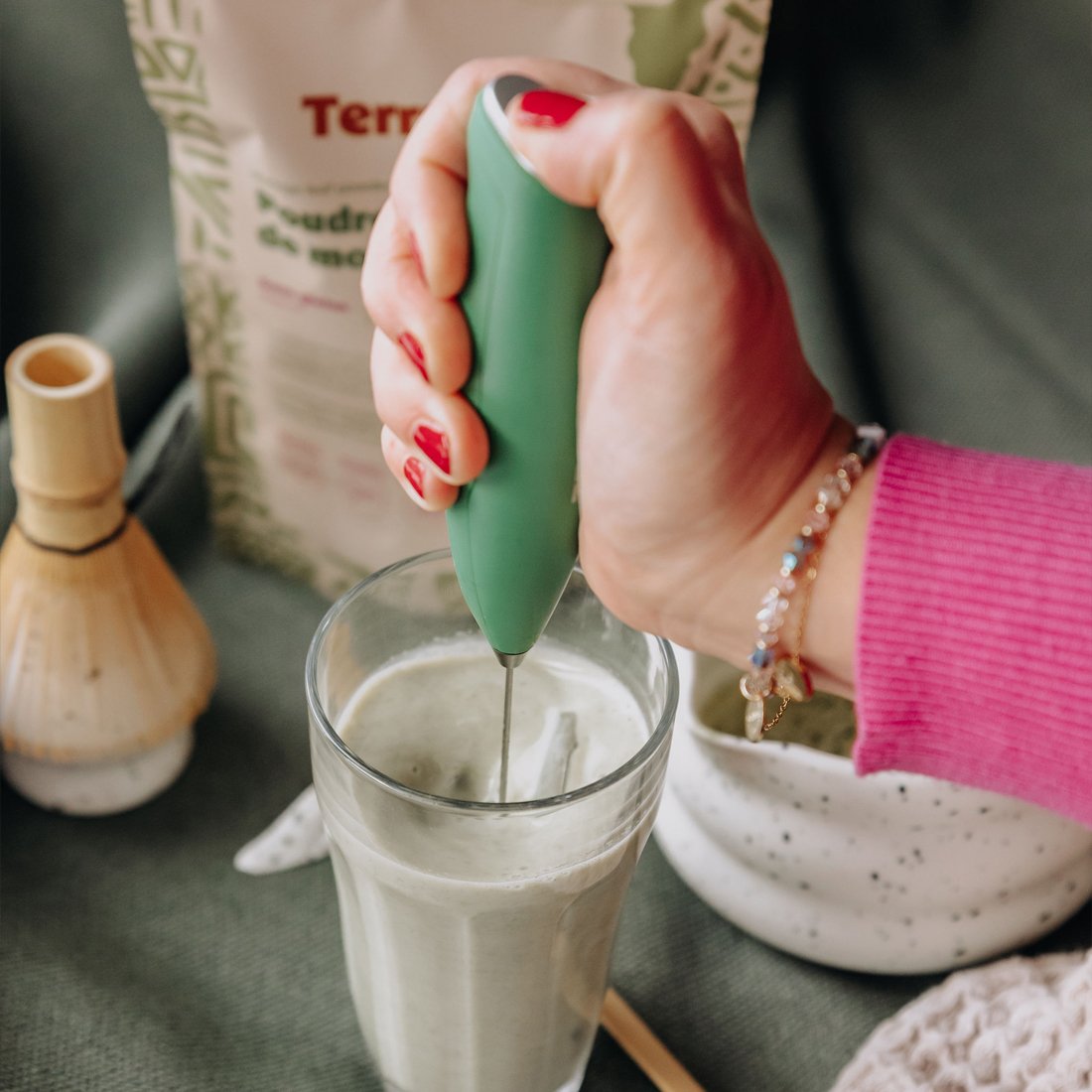
Want some ideas? Our caffeine-free moringa latte is the perfect recipe to start with, and our complete guide to moringa walks you through its benefits, origin, and uses in detail.
Moringa latte: hot or iced, any time of day.
Our verdict
Stick with matcha if you love its taste, its morning ritual, and the calm focus that comes from its caffeine, softened by L-theanine. It’s a great product, in its category.
Choose moringa if you want the green without the caffeine, a broader nutrient profile (protein, iron, calcium, vitamin A), a milder taste, and a cost per cup that makes it a true everyday staple—morning and night.
Many of our customers enjoy both: matcha in the morning for the ritual and the energy boost, moringa the rest of the day for its nutritional base, and in the evening without worrying about sleep.
FAQ & precautions
Does matcha block iron absorption?
Matcha contains no iron, and its polyphenols can reduce iron absorption from a meal eaten at the same time. It’s a matter of timing: spacing matcha out from meals lessens the effect.
Can you take moringa at night?
Yes. Moringa contains no caffeine, so it won’t interfere with sleep. As a hot latte, it’s an ideal end-of-day drink.
Is moringa suitable during pregnancy or with medications?
As a precaution, talk to your healthcare professional before using it regularly, especially during pregnancy or if you take medications.
Can you use both?
Yes. Many people keep matcha for the morning and moringa for the rest of the day. Both have their place, at different times.
Conclusion
Matcha and moringa meet different needs: one is a caffeinated ritual, concentrated in antioxidants; the other is a complete green food, caffeine-free and easy to work into everyday life. The right choice depends on what you’re looking for—and there’s nothing stopping you from enjoying both.
Want to try moringa?
Discover our moringa powder and start gently, one spoonful at a time. To explore all three of our green and fruity rituals at once, The Ritual Trio brings together moringa, baobab, and hibiscus ($32.99 for the discovery size). And as always at Terraïka: shipping is free anywhere in Canada on orders of $60 or more.